A decision in buying the right type of helmet is maybe the most important one after you have got your bike. You do not want to get it wrong and suffer the consequences because of your decision.
In some instances it will be obvious what you should be wearing. If you are racing motorcross then you know you need the motorcross helmet of course. Similarly if you are riding at sports bike at a track day then a full face helmet is whats required otherwise they will likely ask you to sit out.
The main difference as far as looks go is the motorcross helmet has a protruding pointed chin and a wide opening for visibilty with a peak and no visor , compared to the full face helmet that is a streamlined shell, complete with a visor.
There are always reasons behind the designs and their purpose, of which we will take a look at later.
In terms of what helmet is best and the differences involved, that is what we are also going to look at in this post. We shall cover protection, benefits, other types of helmet, and different brands to name a few.
Main Comparisons Between Full Face and Motocross Helemts
| Full Face Helmet | Motocross Helmet |
| Large visor that seals the helmet when closed | No visor, uses goggles instead |
| Safest type of helmet | Peak on the top for sun and debris protection |
| Streamline in design | Protruding chin designed for motocross sport |
| Super light weight |
Motorbike Helmet Types & What They Are Designed For
There are 4 main categories of helmet,
- Full Face helmet
- Off Road helmet (motocross)
- Dual Sports Helmet
- Open Face Helmet
Full Face Helmets
The most common type of helmet for riding your bike on the road is the full face design and it does what it suggests, covers the entire face and head.
The design of these helmets are a streamlined one with a fully closing visor over the front of the face which acts like a window, and air vents located anywhere around the front, normally the jaw bone and forehead areas to allow air flow into the helmet, which helps prevent misting and gives the rider some cooling comfort.
The protection these helmets provide is vital when road riding as this is where you are likely to achieve the fastest speeds when compared to track and trial riding for example. Therefore they are made to withstand greater impacts to protect the rider if they were to crash.
It is of particluar importance to note that the helmet is constructed as a complete unit with no breaks in the design. This gives the product maximum strenght from the materials it is made from.
A variation of the full face is the one that has front flipping element to it, known as a flip or modular helmet. There is a trigger/button inside, located infront the chin, that when pressed releases the the ‘jaw bone’ section of the helmet which is hinged. This is pushed upwards over the forehead and takes the visor with it.
These offer less protection compared to the full face because there will always be an area of weakness when another compenont is introduced into a design, in this case the hinge. They will also incur slightly more weight than the full face designs for the same reason.
Modular helmets are basically a hybrid between an open face helmet and a full face helmet and are worn by all types of riders. They offer the convenience of an open face when up, although you wont be able to ride at tope speeds due to the additional drag when the helmet is in this position. They also allow the rider the weather protection of a full face as they can completely shut out the rain and other elements by pulling the hinged module closed.
Open Face Helmets
There are 2 variations, the half and 3/4 open face. The half open helmet literally has the whole of the face, from the eyebrows down to the chin exposed. The difference between the 3/4 and half is the 3/4 helmet will generally cover ears and base of the head, top of the neck where as the half, depending upon manufacturer and design could be cut off as far up as above the ears and only partially cover the lower head area. It more sits on top of the head rather than encasing it.
When most people think of an open faced style it is the 3/4 helmet that comes to mind, and to be honest I cant remember the last time I have seen anyone using a half open deisgn around where I live.
Both of these variations offer terrible protection in comparison to other styles and personally I would never wear one of these unless dressing for a fancy dress party perhaps and I wasn’t riding to it!
You can easy get your jaw ripped off if you crash wearing one of these, and you dont need to be going to fast to do so.
You tend to see scooter riders wearing these as part of an overall image they are going for.
Motocross Helmets
My favourite looking style but then I’m a dirtbike rider and you’re reading a dirtbike blog!!
I mean just look at how awesome this FOX V3 looks.

These are obviously worn on the motocross track and also used for trail riding. The design gives the rider maximum air flow around the face by having no visor and will usually wear googles, although if used for road then maybe protective shades.
They are super lightweight which helps the rider from getting fatigue when racing.
The chin on these helmets protrude out and this is for providing chin protection during the sport of motocross, from when the rider takes a hit on the handle bars, flying debris and from potential branches and the like when trial riding.
The helmet opening on the face is alot larger than full face helmets because you need a greater field of vision when racing.
You will also notice a peak on the top of the helmet, and this protects the rider from sun in the eyes and again from debris and branches etc.
When riding on the road with these you will feel the peak giving you some resitance at higher speeds. This isn’t a problem when you are flying round a track because your top speed is alot less, but when on the road it can be abit dangerous if you’re not used to it and are not expecting it as it sometimes catches the wind and jolts your head back.
Dual Sports Helmets
This is a hybrid between the dirtbike/motocross style and the full face helmet and provides a very good option for people who want to ride dirtbikes on the road. You are getting the best of both worlds in this design. The look of the motocross style combined with abit more protection and other features handy for the road rider, such as the full visor.
Options for some helmets will include the usual tech like bluetooth speakers and tinted visors etc.
Safety Standards
It goes without saying really that no matter what style of riding you are into you should be looking at the safety standards a helmet is offering you before you make a purchase.
It will depend on the location where you live as to what the legal requirements are, but here in the UK we have a couple of safety standards and the helmet will need to meet at least one of them. The main one known is BS 6658:1985 and a helmet that meets this standard will carry the BSI Kitemark.
The second standard is UNECE Regulation 22.05 so if you helmet has either one of these or both you are good to go.
UK track riding helmets need to meet other standards so we also have a Gold Certifacte sticker on the back of some helmets which denotes the safety standard for helemts sold in the UK for track use and although not a legal requirment for the road it is a good bench mark for when you are considering buying a new one.
Full UK motorcycle helmet requirements can be found on the UK government website here – https://www.gov.uk/motorcycle-helmet-law
In the US they have the DOT sticker which is basically their equivalent mark for implemented safety. In the main they have 3 standards that are most common although there are more. These are DOT, ECE 22.05 and Snell.
DOT stands for Department Of Transport and it is a mark used to denote a standard that is actually called FMVSS 218, which stands for Federal Motor Vehicle Safety Standard #218 .
ECE stands for “Economic Commission for Europe” and the 22.05 is the part that mentions test criteria specs. This is also recognised in the UK as well as 46 other countries.
Snell is another accepted standard and in a nut shell is another set of results from testing carried out by a non-for profit organisation dedicated to helmet safety.
Are DOT Helmets Legal In UK?
This is a common one because people make the logical assumption that US safety standards for motorbike helmets will be the same or similar to that of the UK and therefore the helmet should be legally fine for UK road use. But is that right?
Well as I mentioned above there are 2/3 types of standards that the UK regonise for a helmet to be road legal. The first is the British Standard 6658:1985, and the second is UNECE Regulation 22.05.
As well as these 2 the UK recognises European Economic Area member standards which are equivalent to BS 6658:1985 and have the equivalent to the britsih standard kitemark.
It is this third option that may mean a DOT certified US helmet is road legal in to UK because the US will recognise ECE 22.05 which are european standards from 47 countries. Has the helmet got both?
If a US helmet is just marked with the DOT system and not the ECE as well then I assume it wouldn’t pass for being UK legal. But if it is DOT and ECE then that the potential overlap.
With all this in mind there are things worth considering. If you are worried about your DOT motorbike being legal in the UK then you are clearly a sensible enough person to be wearing a certified helmet of some description and you are the one wearing the helmet so you know you have a decent piece of kit on your head.
The fact it may not meet UK regs would mean in thoery you could get into trouble… but I have never been pulled over and asked if my helmet is up to standard and neither do I know of any such cases. Just saying….
Finding Out More About Your Helmets Safety – UK
There is a website (https://sharp.dft.gov.uk/) that provide a database of over 400 helmet models from wide range of manufacturers. They list additional testing data via ratings and info and all helmets meet at least on of the UK road legal requirements which means if your helmet is listed, it is UK road legal.
Cool Helmet Tech and Products:
There are some cool, creative and techy products out there for helmets, more than I realised until I was recently brain storming for a biker friends brithday not long ago.
A couple fo the products I ended buying for myself and some I thought worthy of noting down for your guys and girls as you too may like them.
Most of these products are going to be mainly focused on the full face road helmets as motocross riders either need need them or are maybe just cool enough!
Helmet Strap:
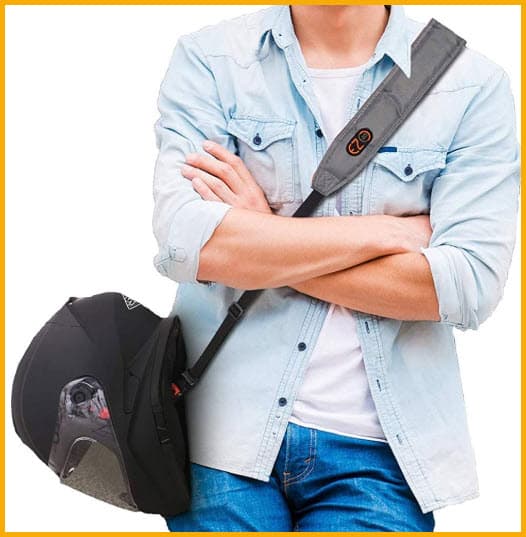
Such a simple idea but quirky and may be good for some. This product is one I bought for a friend as he hates leaving his helmet with his bike but equally thinks it is a pain to hold when having a drink at a meet up.
This helmet strap is worn over your shoulder and going diagonally to your opposite hip where you attached your helmet using the helmet chin strap. If the chin strap isnt compatible with the connection then simply do up your chin strap and thread the helmets strap product through and do it up on itself, this makes it compatible with all helmets.
Helmet Cameras:
I’m sure you have either got one of these or seen them. I have a GoPro, one of the older models, it’s a GoPro Hero 3 I think but still does the job.
Loads of alternatives on the market but tech like this just amazes me. 10 it was probably just hitting the scene and with a high price tag but nowadays you can pick up a cheap helmet cam for $50. That is peanuts.
Bluetooth Setup – Helmet Comms:
I will probably be doing more a review style post on these in the not to distant future as me a buddy are planning dirtbike trip over the alps and will need to invest in some comms gear.
I have used these several times but never bought my own. You can buy full faced helmets with bluetooth already intergrated which is cool if you are fine with paying for the extra tech in your helmet, for the rest you will just buy a bluetooth headset that is designed to be used with a motorbike helmet.